
See descriptions of different student talks and workshops that Think Maths run below.
Click THIS PAGE for more information for a quick way to see which sessions are suitable for different age groups/group sizes, as well as for more logistical information about a visit.
Many of these sessions can be delivered as interactive virtual sessions as well as in person sessions – get in touch to find out more.
We are also available to deliver teacher CPD.
Email info@think-maths.co.uk for availability, fees and to book.
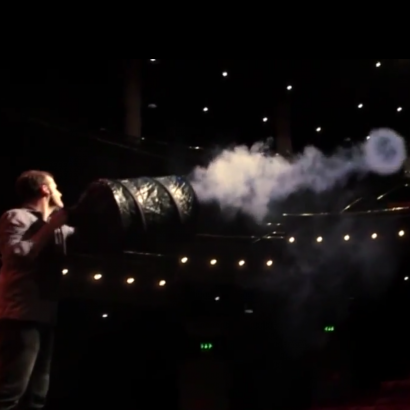
Shapes and Smoke Rings
Upper KS2, KS3, KS4, KS5.
Presentation (unlimited audience size).
Presentation with hands-on mobius loop activity included
(for maximum of 60 students).
This is shape, but not as you’ve seen it before! Join Zoe in this engaging talk to explore the curious world of shape. We’ll be dipping our toes into the mind-bending world of topology (with ideas for activities you can try back in the classroom or at home), we’ll get the whole audience ‘dancing’ (in their seats) whilst exploring spherical geometry, and we will learn the maths and science behind an exciting smoke rings demonstration.
Topics: linking puzzles, Mobius loops, spherical geometry, smoke rings & fluid dynamics.
Mathematical Magic

Upper KS2, KS3, KS4:
Presentation with pair-work section with playing cards (for maximum of 80 students).
Presentation without pair-work section (for unlimited audience size)
Higher ability Y10, 11, or KS5:
Workshop for maximum of 40 students.
Magic tricks might seem impossible, but they’re often just a case of
following a set of steps – just like a maths problem. This session will give students the chance to apply their mathematical thinking skills to reverse-engineer a card trick(s), as well as see and unpick calculator trick(s) that work because of maths.
Topics: Tricks included in the session vary depending on age group and length of session, but broadly speaking, the topics are – reverse engineering a magic trick, self-working (algorithmic) card tricks, learning a maths card trick, a calculator trick that involves some number work.
The Hidden Maths of Technology

KS3, KS4, KS5. Presentation.
There are numbers all around us that make our modern lives possible. From rescuing your lost words in text messages, to taking selfies, maths is always there making things work.
In this session we explore the mathematics behind modern technology via a series of surprising, interactive, audience magic tricks. Ultimately we discover that because maths is essential for technology, ‘if you study maths, you will be essential too’!
Topics: barcodes and check digits, error correction, binary numbers & ASCII, mathematics behind digital images.
Freaky Probability

KS3, KS4, KS5. Presentation.
Humans are generally bad at intuitively understanding probability – not because they don’t understand maths, but because it’s often counterintuitive. Through a series of audience games, students will discover that the chances are not always what we might imagine. This session will help students to use their maths skills to predict and understand the outcomes of games and real life scenarios.
Topics: lottery probability, birthday coincidences, Penney’s game.
Paper Folding and Problem Solving

Upper KS2, KS3, KS4, KS5. Workshop.
Even a simple piece of A4 paper has interesting mathematical properties, and can be folded to build amazing structures. In this workshop students are challenged to use their mathematical and spatial thinking skills to build a paper dodecahedron in teams, and test their problem solving skills simply by folding paper.
Topics: building a dodecahedron, geometry, 3D spatial thinking.
Fractal Building
Upper KS2, KS3, KS4, KS5. Workshop.
90 minutes ideally, could be shorter for some groups.
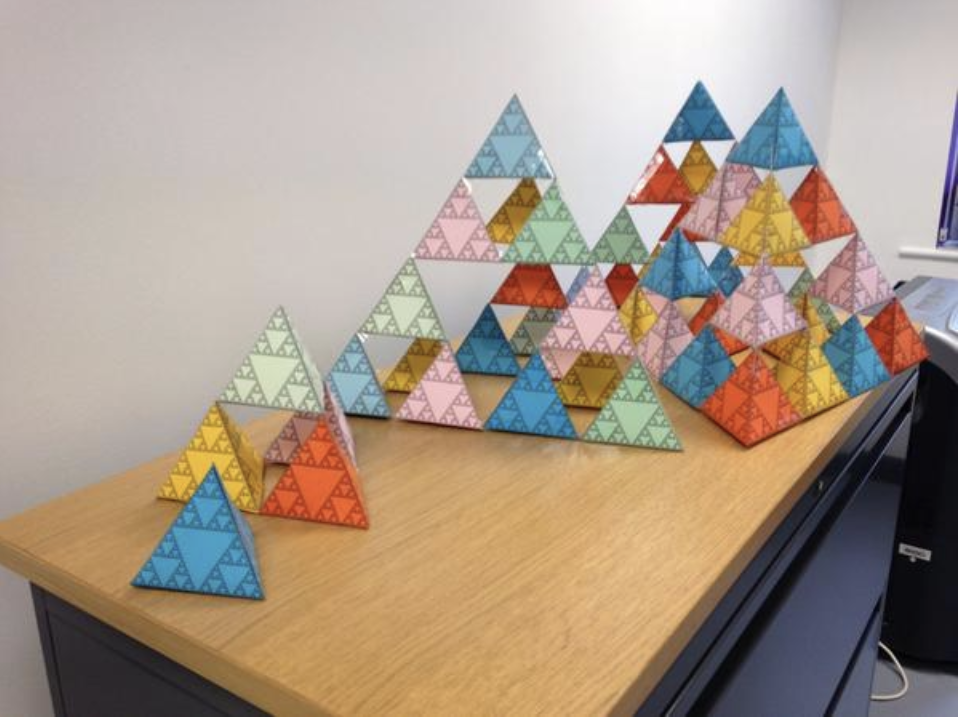
In fractal shapes, the pattern you see in the whole shape is repeated within the shape at a smaller scale. And within those smaller parts of the shape, the patterns are repeated again at an even smaller scale. This process goes on forever, until the pattern is repeated at infinitesimally small scales.
In this hands-on workshop, students will be introduced to the wonder of fractals and will build a Sierpinski Tetrahedron (the 3D version of the Sierpinski Triangle). Each small group will build a small Sierpinski Tetrahedron and then we will try to put all these together to build a giant Sierpinski Tetrahedron across the whole session!
The Power of Patterns

KS3, KS4, KS5 – Presentation. ONLY FOR EVENTS WHERE ALL AUDIENCE MEMBERS HAVE ACCESS TO A PHONE (eg family events).
As humans our relationship with patterns is complex; whilst we often harness the power of patterns to make predictions and are very good at spotting patterns in the world around us, we are not always good at understanding what patterns mean.
In this interactive talk we will explore the power and place of patterns in our world, via a series of exciting audience experiments. We will investigate powerful patterns we have created, patterns we’ve found in the world around us, as well as patterns that might well trip us up.
Maths and You
KS4, KS5.
Presentation

In this presentation we explore a fews of ways that maths is relevant to YOU in your every day lives, and how the same bits of maths could also be part of the story of YOU, in your future career. Across the session we dip our toes into a range of topics from statistics in the media to maths in technology. The session includes interactivities such as an audience trick, an audience game and an audience experiment, and features a few case studies of real people who use maths in interesting ways in their work.
Topics: topics vary depending on the audience, but will include some statistics, and some maths in technology.
Numbers in the News

KS4, KS5 – Presentation.
It’s important to be able to think critically about what we are told in the media. This thought provoking and amusing talk, featuring audience games and experiments, takes students on a tour of misleading and difficult to understand statistics from real news stories. Choose this talk to inspire the statisticians of the future and empower your students to make informed decisions in their own lives.
Topics: Misrepresentation of data, miscommunication of risk/chance including relative risk and the national lottery, and randomised response demo.
Domino Computing
KS4, KS5. Workshop.
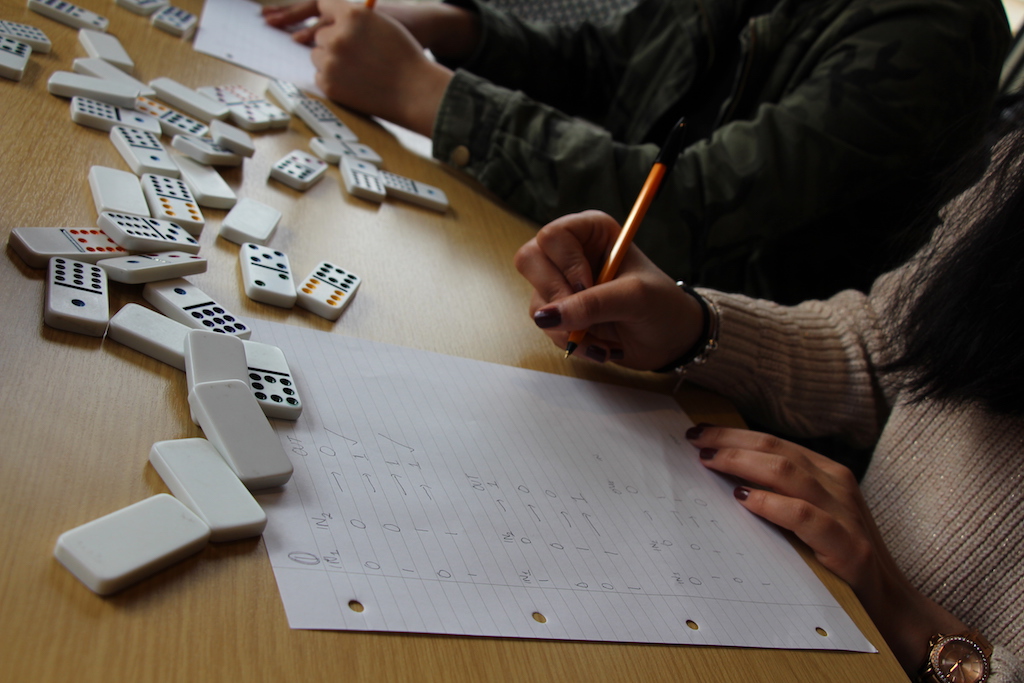
A single domino in a run can either be standing up or lying down – and this is analogous to the zeroes and ones of the binary number system used by modern computers. In this workshop, using only dominoes, students will build logic circuits and will see how a computer that adds numbers can be constructed entirely from dominoes. Students will use their problem solving skills and will learn how computers function on a basic level.
Topics: binary numbers, addition in binary, logic gates.
Maths in the Simpsons
Higher ability Year 11, KS5. Presentation.
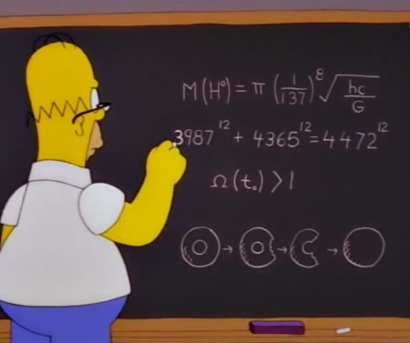
Very few people associate The Simpsons with mathematics, but if you look closely at the episodes there is plenty of mathematics to be found. This presentation will touch on a number of different higher level areas of mathematics, in particular some number theory topics, while illustrating that an understanding of mathematics will be an asset in any career.
Topics: prime numbers, number theory, Fermat’s Last Theorem.
Adventures in the Fourth Dimension
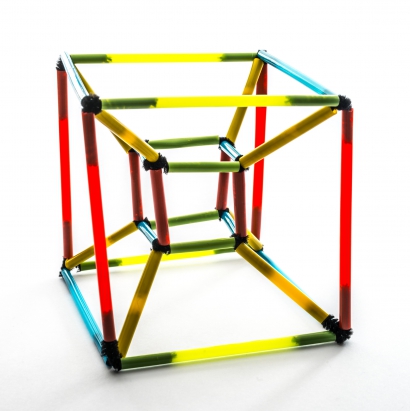
Higher ability Year 10/11, KS5. Presentation.
This presentation introduces students to mind-bending shapes that exist in the 4th dimension in a highly visual and easily accessible manner. Students will have the opportunity to apply their mathematical thinking skills to higher dimensions and non-orientable shapes.
Topics: mobius loops, Klein bottle & 4D surfaces, hypercubes, 4D Rubik’s cube.